Residential Hindu student centers across North America · A project of the Hindu Society of America

A permanent Hindu presence on campus.

Hindu student groups exist on many campuses, but they struggle with continuity: the population that builds them graduates out of them every few years. A house is the part that stays.

A project of the Hindu Society of America

Who are we

The growing Hindu student population in American universities has highlighted the need for establishing Hindu Cultural Centers on college campuses. These centers would ensure a consistent Hindu presence and perspective within academic settings.

The proposed solution is the Vivekananda House: a residential facility designed to serve as a central hub for Hindu cultural activities and events, modeled after existing cultural houses on U.S. campuses. This initiative, led by the Hindu Society of America, seeks to institutionalize Hindu representation in university life.

Our Mission

Our mission is to give Hindu students opportunities to practice Hindu culture: through Sewa (selfless service), by connecting with the larger issues affecting Hindus nationally and globally, by keeping a library of Hindu books at each Vivekananda House, and by creating a conducive space for students to grow into volunteers for Hindu causes.

Vivekananda Houses serve as the backbone and support for their respective Hindu YUVA chapters, giving campus teams a physical space to run events and serve the on-campus Hindu community, with resources like a meditation room, music room, library, hangout space, study space, open kitchen, and puja room.
Our Vision

Our vision is to create a Hindu Students Center on all major campuses in the United States that will become a central place for Hindu Spiritual Guidance, Hindu Activism, and service-oriented activities on the campus and beyond.

The Hindu student population on American campuses continues to grow, highlighting the increasing need for establishing Hindu cultural centers at colleges across the United States. Currently, there is a significant lack of Hindu representation within the university setting. Since all influential members of society pass through the university system at some point, a strong Hindu presence on campus is essential for bringing Hindu perspectives into the broader discourse of our nation.

What a house gives

Three things a student group cannot rent by the evening.

Residence

A room of your own and a house full of friends, minutes from campus. Four to five students live on the second floor.

Library

A collection of Hindu texts, study tables, and quiet hours kept for reading and reflection.

Seva

Cook, host, and serve. The first floor is given over to cultural events, yoga, pranayama, chanting, and discussion.

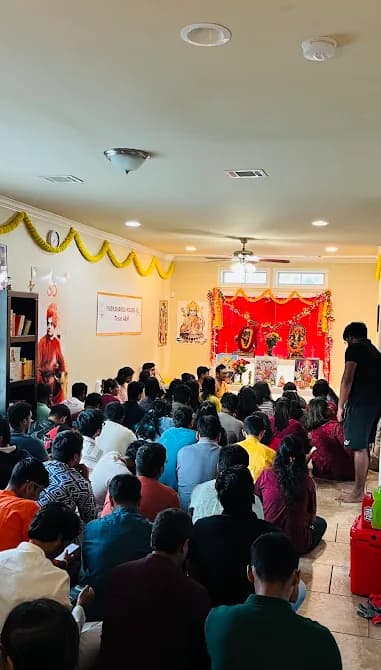
The front room of the Texas A&M house during satsang, students seated before the shrine
Texas A&M · The first floor, given over to Dharmic activity

Impact on campuses

  • The premises can be leased to other like-minded organizations to run their workshops.
  • It serves as a go-to place for the Hindu student community in case of any social issue or need for collective representation.
  • A prime location in campus-town creates a soft strength for the Hindu community, students and families alike.

Philosophy

American universities have a long tradition of cultural and religious houses that are integral to campus life and exert a strong influence on students. Many of these organizations maintain residence houses as their central hub, sustaining their presence and shaping students' daily experiences.

With the growing need for Hindu representation and the increasing number of Hindu students on campus, a similar institutional structure could serve as a focal point for Hindu representation at universities. This is where the concept of the Vivekananda House comes into play: a residential facility that accommodates four to five students on the second floor, with the first floor dedicated to Dharmic activities such as cultural events, yoga, pranayama, chanting, and discussions and lectures on Hindu Dharma.

Support a house, or make one your home.

The Inquire form reaches the national organization directly. It is the same form residents use.